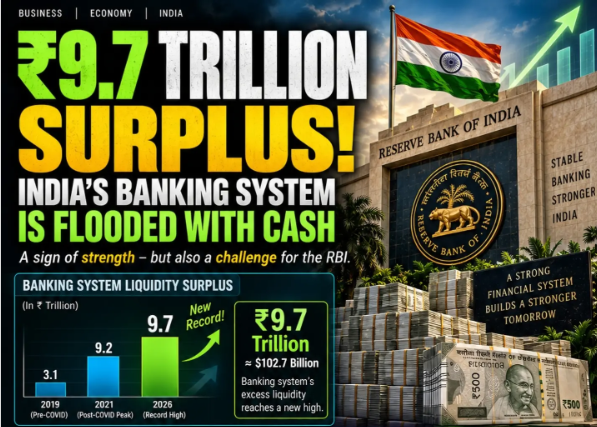
More money sounds like good news. So why is the RBI trying to take some of it back?
India’s banking system is currently flooded with liquidity. By September 3, the surplus had reached around ₹9.7 lakh crore — one of the highest levels seen in recent years.
But here’s the catch:
Money sitting idle in banks isn’t necessarily good for the economy.
A major reason behind the surge is the huge inflow of foreign-currency deposits. Banks brought in around $127 billion through the special FCNR(B) scheme, and the resulting transactions added a massive amount of rupee liquidity to the financial system.
So, what’s the problem?
When banks have more money than they need, they may be willing to lend or trade funds at lower rates. That can push short-term market rates below the RBI’s policy rate.
Sounds great for borrowers, right?
Not necessarily.
If excess liquidity persists, it can complicate the RBI’s control over interest rates and potentially add to inflationary pressures. That’s why the central bank is now trying to absorb some of this surplus through tools such as Variable Rate Reverse Repo (VRRR) operations.
The bigger question
India has managed to attract a huge amount of foreign capital and strengthen its external position. But now comes the harder part:
How do you manage all that money without letting it distort the financial system?
That’s the RBI’s problem of plenty.
And sometimes, in economics, too much money can be just as complicated as too little.