
AI is everywhere. But here’s the billion-dollar question: What is it actually worth?
From chatbots and autonomous systems to AI-powered healthcare and finance, artificial intelligence is rapidly becoming a core part of modern businesses. Investors, however, face a difficult challenge: how do you value a company when its biggest opportunity may still be years away?
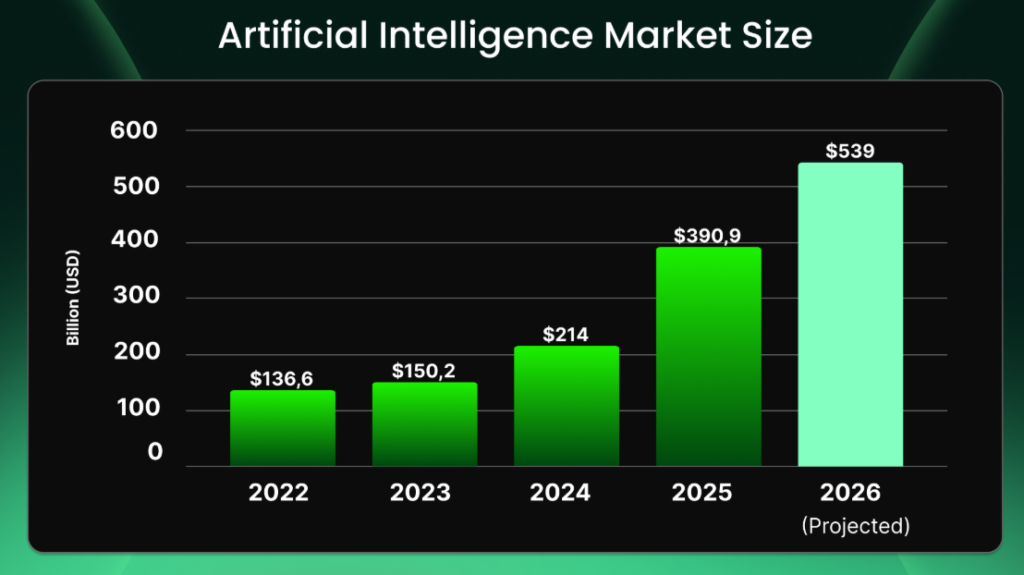
Following is the size of the AI Industry-
The Problem With Traditional Valuation
Traditional valuation methods such as DCF, P/E and EV/EBITDA rely heavily on historical financial performance and reasonably predictable future cash flows.
AI companies can be different.
A company may be spending heavily today on computing power, talent and research while expecting significant revenue years later. That makes today’s numbers look weak—even when the underlying opportunity is enormous.
So, What Should Investors Look At?
Think beyond today’s revenue.
1. AI Revenue Potential
How much of the company’s future revenue could actually come from AI?
2. Competitive Advantage
Does the company own valuable data, technology, infrastructure or intellectual property?
3. Adoption
Are customers actually paying for the AI product—or is it just generating headlines?
4. Cost of AI
AI isn’t free. Computing power, chips, data centres and skilled talent can be extremely expensive. High revenue growth means little if costs grow even faster.
5. Future Cash Flows
Ultimately, valuation comes back to one fundamental question:
How much cash can this business generate in the future?
The AI Valuation Trap
The biggest danger isn’t necessarily that AI companies are bad businesses.
It’s paying too much for a great business. Many people are sceptical about the valuation
If investors assume extraordinary growth, huge margins and almost no competition, even a small disappointment can cause a massive change in valuation.
That’s why AI valuation is less about asking:
“Is AI the future?”
and more about asking:
“How much of that future is already priced into the stock?”

AI boom heading for a dot-com style bust? ‘Dean of Valuation’ Aswath Damodaran warns correction could be more painful than 2008- Economic Times
The Bottom Line
AI may transform industries—but transformation alone doesn’t determine valuation.
Great technology ≠ automatically great investment.
The real skill is connecting AI’s potential to realistic revenue, costs, cash flows and risk.
Because in valuation, the most exciting story isn’t always the most valuable one.